

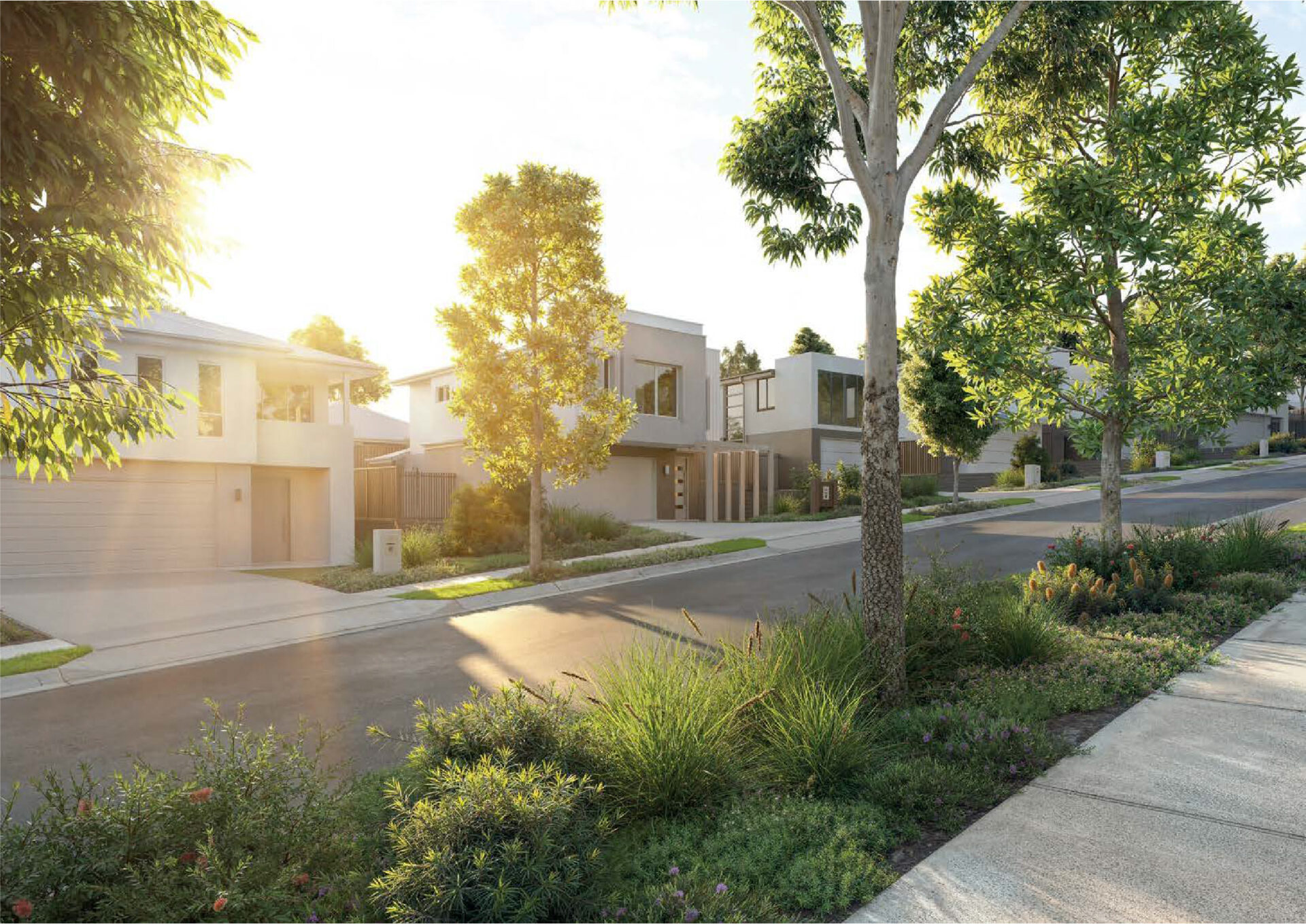
Positioning and Setbacks
4.1 Positioning
- Home design should respond to the site’s natural features, including sunlight, breezes, views, and surroundings.
- Consider outlook, solar access, neighbouring homes, and opportunities for north-facing outdoor spaces.
- Key factors to address:
- Views and vistas
- Prevailing breezes
- Sun angles
- Streetscape character
- Orientation relative to neighbouring properties
- Western-facing lots should include shading elements (roof overhangs, screens, window hoods, covered terraces) to improve comfort and energy efficiency.
- Climate-responsive design guidance is provided in the Sustainable Living section.
- On Green Street allotments, living areas should face the green street to maximise views, daylight, and connection to landscaping.
4.2 Setbacks
- Correct setback information is provided in the Disclosure Plan and House Siting Plan on the Builder Portal.
- Plans specify front, side, and rear setbacks, plus site coverage requirements.
- Setbacks must comply with the approved Plan of Development.
- Setbacks are measured from the outermost projection of the building or structure.
4.3 Built-to-Boundary Requirements
- Built-to-boundary walls may be up to 15 m or 50% of the boundary length (whichever is greater).
- Maximum wall height is 3.5 m.
- Built-to-boundary walls must not contain windows or openings to the side boundary.
FIGURE 2 – PLAN OF DEVELOPMENT SETBACKS TABLE
| Lot Typology | Villa Allotments | Villa Allotments | Premium Villa Allotments | Premium Villa Allotments | Courtyard / Premium Courtyard Allotments | Courtyard / Premium Courtyard Allotments | Traditional Allotments | Traditional Allotments |
|---|---|---|---|---|---|---|---|---|
| Typical Lot Width* | 10m Wide | 10m Wide | 12.5m Wide | 12.5m Wide | 14m and 15m Wide | 14m and 15m Wide | 17m+ Wide | 17m+ Wide |
| Elevation | Ground Floor | First Floor | Ground Floor | First Floor | Ground Floor | First Floor | Ground Floor | First Floor |
| Front Setbacks (Metres) | Front Setbacks (Metres) | Front Setbacks (Metres) | Front Setbacks (Metres) | Front Setbacks (Metres) | Front Setbacks (Metres) | Front Setbacks (Metres) | Front Setbacks (Metres) | Front Setbacks (Metres) |
| Front Wall | 3.0 | 3.0 | 3.0 | 3.0 | 3.0 | 3.0 | 3.0 | 3.0 |
| Garage | 5.0 | n/a | 5.0 | n/a | 5.0 | n/a | 5.0 | n/a |
| Corner Allotments (Metres) | Corner Allotments (Metres) | Corner Allotments (Metres) | Corner Allotments (Metres) | Corner Allotments (Metres) | Corner Allotments (Metres) | Corner Allotments (Metres) | Corner Allotments (Metres) | Corner Allotments (Metres) |
| Secondary Road Frontage | 1.5 | 1.5 | 1.5 | 2.0 | 1.5 | 2.0 | 1.5 | 2.0 |
| Rear Setbacks (Metres) | Rear Setbacks (Metres) | Rear Setbacks (Metres) | Rear Setbacks (Metres) | Rear Setbacks (Metres) | Rear Setbacks (Metres) | Rear Setbacks (Metres) | Rear Setbacks (Metres) | Rear Setbacks (Metres) |
| Lot Depth ≤28m | 1.0 | 1.0 | 1.0 | 1.0 | 1.5 | 2.0 | 1.5 | 2.0 |
| Lot Depth >28m | 3.0 | 3.0 | 3.0 | 3.0 | 3.0 | 3.0 | 3.0 | 3.0 |
| Lots with Double Tier Retaining Walls >3m | 1.5 | 1.5 | 1.5 | 1.5 | 1.5 | 1.5 | 1.5 | 1.5 |
| Park / Open Space Setback (Metres) | Park / Open Space Setback (Metres) | Park / Open Space Setback (Metres) | Park / Open Space Setback (Metres) | Park / Open Space Setback (Metres) | Park / Open Space Setback (Metres) | Park / Open Space Setback (Metres) | Park / Open Space Setback (Metres) | Park / Open Space Setback (Metres) |
| Side | 1.5 | 1.5 | 1.5 | 2.0 | 1.5 | 2.0 | 1.5 | 2.0 |
| Side – General Lots (Metres) | Side – General Lots (Metres) | Side – General Lots (Metres) | Side – General Lots (Metres) | Side – General Lots (Metres) | Side – General Lots (Metres) | Side – General Lots (Metres) | Side – General Lots (Metres) | Side – General Lots (Metres) |
| Built to Boundary | 0.0–0.2 | 1.0 | 0.0–0.2 | 1.0 | 0.0–0.2 | 1.0 | 0.0–0.2 | 1.0 |
| Non-Built to Boundary | 0.75 | 0.75 | 1.0 | 1.0 | 1.0 | 1.0 | 1.5 | 1.5 |
| Maximum Site Cover | 65% | 65% | 60% | 60% |
- Lot typology is generally based on typical frontage width, except irregular and corner allotments where lot typologies are nominated based on the largest regular allotment building envelope. The Plan of Development (POD) will identify the lot typology for your lot.
4.4 General External Materials and Finishes
- Homes must use a mix of materials and colours to create visual interest, especially on walls facing streets, open spaces, or parks.
- Facades must include:
- 2–3 colour variations, and
- At least two different materials (excluding windows, doors, and garage doors).
- Any colour or material change must cover at least 10% of the facade wall area.
- Approved primary building materials include:
- Rendered and painted brickwork
- Rendered and painted masonry blocks
- Lightweight cladding materials (e.g. Stria, Axon, Matrix, Linea weatherboards).
- Face brickwork and split-face blockwork are only permitted as feature elements, not as the main material.
- Bagged and painted brickwork is allowed only if not visible from public areas.
- Unpainted metalwork is not permitted, though small feature elements (e.g. Colorbond® cladding) may be approved at the discretion of the DRP
- The Design Review Panel (DRP) can require architectural features to be revised or removed if they do not align with the intended character of the home or the broader community.
- All designs must comply with the Design Guidelines and overall vision for Round Mountain.
- Every covenant application must include an external materials schedule.
- The materials schedule must clearly show proposed materials and their locations to demonstrate the home’s quality and design character.
4.5 Feature Materials and Finishes
- At least one high-quality feature material is required on all facades facing public areas, to complement the primary building material.
- Approved feature materials include:
- Natural timber or timber-look materials
- Premium feature brickwork (max 20% of facade) with off-white or colour-matched mortar
- Premium tiles or stone that complement the exterior colour palette
- Premium natural stone
- Large glazing, including butted windows and picture windows
- Powder-coated screening where it forms a dominant facade feature
- Samples and reference images of feature bricks, stone, and tiles must be submitted for approval.
- Feature materials must be integrated with the main material by wrapping around columns and wall returns by at least 1 metre.
- Unpainted metalwork is not permitted; limited Colorbond® cladding may be allowed at the DRP’s discretion.
- Contemporary window hoods are recommended where suitable to help articulate the facade.
- The DRP may require the removal of any feature that does not align with the overall character of the home or community.
4.6 Facade Design
- Facade requirements apply to all facades visible from public areas, including front facades, secondary frontages, and green street lots.
4.7 Front Facade Aesthetic
- Homes must have a contemporary modern aesthetic that reflects Queensland architecture and design.
- Primary street-facing facades must include sufficient glazing to enable passive surveillance.
- Minimum ground floor ceiling height: 2590 mm.
- Maximum building height: 9 m.
- Buildings are limited to two storeys.
- Facades must incorporate feature walls and/or large glazing elements.
- Design articulation is required through horizontal and vertical elements (e.g. columns, blade walls, parapets) to break up the roofline and add visual interest.
- A variety of complementary materials and glazing must be used to achieve a balanced mix of light and heavy elements.
4.8 Defined Entry
- A portico, porch, or balcony is required to clearly define the main entrance.
- The entry feature must:
- Be proportional to the facade and designed as a facade feature.
- Extend at least 1500 mm forward of the entrance door.
- Remain open, with a maximum height of 4.5 m and maximum width of 3 m.
- The entry door must be clearly visible from the primary street frontage and be either:
- 1200 mm wide with at least 20% glazing, or
- 1000 mm wide with a minimum 200 mm sidelight.
- A dedicated pedestrian path is required from the front boundary to the entry.
- Side entries are only permitted on lots 10 m wide or less, must be defined with a gatehouse or arbour, and are subject to DRP approval.
4.9 Varying Facades
- Identical facades are not permitted on adjoining lots to ensure a visually diverse streetscape.
- Each home must have distinctive architectural features that differentiate it from neighbouring dwellings.
- Variation is required in elements such as:
- Rooflines
- Entry design
- Colour schemes
- Materials
- Homeowners should consult with their builder and the DRP to identify nearby similar designs.
- Where similar designs occur, adjustments to design, colours, or materials are encouraged to enhance individuality.
4.10 Corner Allotment – Facade Design
- Corner lots and homes adjoining public areas must provide architectural articulation to both the front and secondary frontage.
- Facade material, articulation, and aesthetic requirements apply equally to both the primary and secondary street facades.
- The secondary frontage must include:
- At least one substantial projecting element (e.g. portico, veranda, or feature wall), and
- Variation in colour and/or materials.
- To avoid long blank walls, a minimum 450 mm perpendicular wall step is required every 9 m.
- Homes adjoining open space must enable passive surveillance, typically by orienting at least one habitable room towards the open space.
- Utilities and structures (e.g. garden sheds, air-conditioning units, clotheslines) are not permitted between the secondary street facade and boundary unless fully screened from view.
4.11 Green Street Lots – Additional Requirements
- Green street homes must respond to their unique location with strong articulation in facade design, roof forms, and materials, including the rear elevation.
- A habitable room with substantial glazing is required at the rear to provide casual surveillance of the green street, in addition to primary street requirements.
- For two-storey homes, the habitable room must be located on the upper level.
- The use of rear balconies or decks is strongly encouraged to maximise views of the green street landscaping.
- Roof articulation at the front of the dwelling must be continued to the rear to ensure a well-articulated overall roof form.
4.12 Split Level Homes
- Split level homes are designed to work with natural land contours, capturing views and breezes.
- These lots include two flat building pads separated by a batter in the middle of the site.
- Split level homes can be:
- Up-split: garage access from the lower side of the lot, or
- Down-split: garage access from the higher side of the lot.
- Both configurations offer elevated living areas and enhanced views to the front or rear.
- Split level lots are positioned to maximise views of the surrounding natural landscape.
- There are specialist builders experienced in split level homes, offering either ready-made designs or custom solutions for these lots.
4.13 Garages
- Garage doors must be modern and contemporary, using sectional slide-over or tilt-up designs in colours/materials complementary to the home.
- Roller doors are not permitted.
- Feature detailing on garage doors is encouraged to enhance the front facade.
- Garages must not exceed 60% of the lot frontage width on lots over 10 m wide.
- Clear transparent glazing is not permitted; limited translucent or obscure glazing may be approved by the DRP.
- Minimum two on-site car spaces are required:
- At least one space within a garage
- At least one off-road visitor space within the driveway.
- Garages must be set back a minimum of 1 m behind the main front wall of the dwelling (excluding porticos).
- Double garages are mandatory on lots 12.5 m wide or greater.
- To maintain streetscape quality:
- Recreational vehicles must be screened or garaged.
- Carports and shade sails are not permitted.
4.14 Single Storey Garages on Villa Allotments
(Lots 10.0–12.49 m wide)
- Double garages must meet the following:
- Maximum front facade width (including garage): 5.8 m
- Garage door width must not exceed 4.8 m
- Minimum 450 mm eave or overhang above the garage door
- Garage door to be setback at least 240 mm behind the garage pillar
- Garage door must be sectional, tilt, or integrated
4.15 Electric Vehicle Readiness
- Each home must include a dedicated electric vehicle circuit run to the garage.
- The circuit must include conduit, wiring, and a minimum 20-amp GPO to support future EV charger installation.
Roofs
4.16-4.17 Roof Form – General
- Roofs play a major role in the visual character of homes, streetscapes, and neighbourhoods.
- Roof scale, form, material, design, and colour must be carefully considered.
- A mix of skillion, pitched, and cubic roof forms is encouraged to support contemporary design.
- Hip and gable / hip and valley roofs are permitted if they:
- Are contemporary in style
- Provide variation in roof height and prominence
- Are complemented by vertical and horizontal design elements (e.g. columns, blade walls, parapets)
- Are supported by large glazing areas on the front facade
- All roof designs are subject to DRP assessment for guideline compliance and visual impact.
- Light-coloured roof materials are encouraged to improve thermal performance and reduce heat island effects.
4.18 Roof Articulation
- Roof designs must include articulation, with variation in height and projection.
- The front elevation must feature a pronounced entry element (porch, portico, or veranda) with an elevated roofline.
4.19 Roof Pitch
- Roof pitch must complement the architectural character of the home.
- Permitted pitch ranges:
- Hip roofs: 18°–30°
- Skillion roofs: 5°–15°
- Roof pitches must be selected with public visibility in mind.
- Pitches of less than 10° may be considered if they still demonstrate adequate height and scale from public areas.
4.20 Roof Materials
- Approved roof materials are limited to:
- Corrugated prefinished, coloured metal sheeting
- Low-profile roof tiles
4.21 Eaves, Awnings, and Sun Hoods
- Eaves, awnings, or sun hoods are mandatory as part of passive solar and energy-efficient design.
- For traditional roof forms (e.g. hip and valley, hip and gable):
- Minimum eave width: 450 mm
- Exception applies for built-to-boundary walls
4.22 Roof Colour Selection
- Roof colour selection is essential to creating a cohesive, timeless streetscape.
- Colours must:
- Reflect the architectural style and design of the home
- Use natural, muted tones with crisp base colours
- Highlight colours are allowed only for architectural features.
- Bright or primary colours are not permitted.
- Appropriate roof colours can:
- Reduce the urban heat island effect
- Improve solar performance
- Enhance internal thermal comfort
- Further guidance is provided in the Sustainable Living section of the guidelines.
- Pre-approved Colorbond® roof colours (Solar Absorbance ≤ 0.6) include:
- Dover White
- Surfmist
- Southerly
- Shale Grey
- Evening Haze
- Dune
- Bluegum
- Windspray
4.23 Glazing
- Obscure or translucent glazing is not permitted on any street frontage.
- Reflective glass is not allowed.
- Internal vertical blinds and temporary window treatments are not permitted where visible.
4.24 Balustrade
- Balustrade design must align with the architectural style of the home.
- Recommended balustrade types:
- Frameless glass
- Batten styles
- Powder-coated aluminium
- Timber picket balustrades are only permitted where they enhance a unique architectural style.
4.25 Security and Insect Screens
- Security screens visible from the street must:
- Have a simple profile
- Be integrated into window recesses and facade articulation
- Barrier/Diamond grille screens are not permitted on doors or windows facing primary or secondary frontages or visible from public areas.
- External add-on security screens are not allowed on primary or secondary facades.
- Screen frames must:
- Match door/window frame colours, or
- Be dark-coloured to minimise visual impact.
4.26 External Services and Utilities
- One side of the home must be designated as a utility zone (southern side preferred).
- Items such as bins, clotheslines, air-conditioning units, and rainwater tanks must be located within this zone.
- Utility areas must be screened from public view using fencing and landscaping.
- Meter boxes should be located behind side return fences where possible.
- If mounted on the house, meter boxes must be painted to match the wall colour.
- Gutters and downpipes must match the dwelling colours or be used as deliberate colour accents.
4.27 Privacy and Cross-Viewing
- Homes must include privacy measures to minimise overlooking between neighbouring dwellings.
- Acceptable privacy solutions include:
- Fixed obscure glazing to windows below 1.5 m above floor level
- Fixed obscure glazing to all bathrooms and toilets
- Minimum 1.5 m sill heights above floor level
- Fixed external screens
- Ground-floor fencing at least 1.5 m high
- Balcony side screening to a minimum height of 1.8 m where adjoining lots exist
- All privacy treatments must be clearly shown on plans and elevations submitted to the DRP.
- Where screens are proposed, detailed information (colour, shape, and extent) must be provided.
4.28 Private Open Space Requirements
- Each home must provide at least 12 m² of private open space.
- The space must have a minimum width of 2.4 m in any direction.
- Private open space must be directly accessible from a ground-floor living area.
- A portion of the open space may be roofed.
Retaining Walls
4.29 Mandatory Retaining Wall Requirements
- Full details of all retaining walls and embankments (height, materials, location) must be submitted to the DRP for approval.
- Neighbour consent is required where retaining walls or embankments are within 0.6 m of a boundary or in close proximity.
- Retaining walls may require certification by a registered professional engineer and must comply with local authority requirements.
- Retaining wall heights must not exceed 1.2 m without including a 0.5 m landscaped terrace between stepped wall sections.
- Developer-installed retaining walls must not be altered or removed without consent, including changes to ground levels around them.
- All retaining walls must include an appropriate drainage system connected to a suitable outlet.
Additional Retaining Walls (Owner-Initiated)
- Additional retaining walls may be installed to support the house design and must be shown on the covenant submission for DRP assessment.
- Approved materials for walls forward of the Building Line or visible from public areas include:
- Stone
- Interlocking block walls
- Rendered and painted block walls
- Concrete sleepers, masonry materials, commons brick, timber, and concrete sleepers are not permitted forward of the Building Line.
Fencing
4.30 General Fencing
- Developer-installed fencing must not be altered, modified, or removed without written approval from the developer.
4.31 Internal Side and Rear Fencing
- Side and rear fencing must be installed by the Owner before Practical Completion.
- Fence requirements:
- Maximum height: 1.8 m
- Approved types only:
- Stratco Good Neighbour Wavelok® in Granite, or
- Colorbond® equivalent in Basalt
- No other fence types permitted
- Fencing must:
- Be installed in developer-supplied sleeves
- Use developer-supplied brackets (where part of retaining wall construction)
4.32 External Side Return Fences and External Gate Access
- Side return fences and gates must be:
- Aluminium batten panels
- Maximum height: 1.8 m
- Minimum 30% transparency
- Colour to match boundary fencing (Basalt)
- Side fence returns must be set back 1m behind the front wall of the dwelling.
- Ground-mounted equipment and services must be screened behind side fence returns.
- Colorbond and Stratco fencing is not permitted on fences adjoining public streets – Aluminium batten fencing is mandatory in these locations.
4.33 Secondary Frontage Fencing
- Secondary frontage boundary fencing is:
- Constructed by the Developer
- Located 1m behind the dwelling’s front wall setback
- Must be maintained by the Owner
- Side fence returns and gates on secondary frontages must be constructed by the Owner before Practical Completion.
- Secondary Frontage/Feature Fencing is:
- Aluminium batten panels
- Maximum height of 1.8m
- 40mm batten x 20mm gap
- Maximum 50% transparency.
- Colour: Basalt
4.34 External Front Fencing
- Front fencing is generally discouraged to promote street appeal and passive surveillance.
- Low front fencing may be considered by the DRP if:
- Maximum height: 1.2 m
- Minimum 50% transparency
- Aluminium mini blade.
- Colour: Basalt
- Front fencing is not permitted on lots with BAL-29 or higher.
- Where safety rails are required, they must comply with NCC requirements.
- All front fencing:
- Must align and return to side boundary fencing.
- Must use developer-supplied brackets where applicable.
4.35 Green Street Fencing
- Green Street fencing is installed by the Developer and must not be removed.
- Pedestrian gate access is permitted to allow direct access from the home to the green street.
4.36 Driveways and Entry Paths
- One driveway per lot is permitted and must be included in the covenant application.
- Driveways must be set back a minimum of 0.5m from side boundaries.
- Plain concrete is not permitted; driveways must have at least an exposed aggregate finish.
- Driveways and crossovers must comply with Council requirements.
- All driveways and crossovers must be completed prior to occupation of the dwelling.
- Maximum driveway width at the boundary:
- 3m for single garages
- 4.8m for double garages
4.37 Letterboxes
- Letterboxes must be clearly visible from the primary street frontage and located near the driveway.
- The property number must be clearly displayed.
- Letterboxes must be within the property boundary and integrated with landscaping and fencing.
- Only contemporary designs are permitted, using:
- Rendered brick
- Stone cladding
- Timber
- Colours and styles must complement the home design.
- Letterboxes must be installed prior to occupation.
- Pole-mounted, ornamental, and temporary letterboxes are not permitted.
4.38 Swimming Pools
- All swimming pools must be reviewed and approved by the DRP before installation.
4.39 Garden Sheds
- Sheds must not be visible from streets, primary or secondary frontages, or public spaces.
- Sheds and outbuildings:
- Must be detached from the main dwelling
- Must not exceed 9m² in area
- Maximum height of 1.8m
- Colorbond® sheds are recommended, with colours that complement the home.
4.40 Solar Panels
- Solar panels are strongly encouraged to support sustainable living.
- Solar systems must be considered during the design stage to reduce impacts on neighbours.
- Panels must be:
- Integrated within the roof plane
- Installed at the same pitch as the roof where possible
- Panels mounted on frames above the roof or at different angles should be minimised.
4.41 Air Conditioning Units
- Air conditioning units must not be visible from public areas.
- Units must be:
- Located at ground level
- Screened from public view
- Roof-mounted or unscreened wall/window units facing public areas are not permitted.
- Sound attenuation measures may be required to protect neighbour amenity, at DRP discretion.
4.42 Shade Sails
- Shade sails, shade cloths, and tarps are not permitted.
- Shade sails cannot be used to shade or screen vehicles or recreational vehicles.
4.43 Temporary Structures
- Temporary or relocatable buildings are not permitted, including during construction.
4.44 Other Structures
- Satellite dishes and antennas must not be visible from streets or public areas.
- Roof-mounted hot water systems must also not be visible from primary or secondary frontages or public spaces.